Our communities

image of two people talking over fence

The sheep and beef sector plays an important role in New Zealand’s regional economies and rural communities. Farming contributes to local employment, supports service industries and is part of the social fabric of rural communities. 

Employment and economic activity linked to the sheep and beef sector extend far beyond the farmgate. Processing facilities, transport services and supporting industries all contribute to regional economies. These activities form part of wider supply chains that connect rural production with domestic and international markets.

Red meat sector workforce

icon of a  circular green‑and‑white icon featuring stylised koru‑like curves forming an abstract plant or growth motif, enclosed within a double‑lined border, representing māori trusts and land stewardship.

New Zealand sheep and beef farms are overwhelmingly family owned (over 90 percent) with an average of five people living on each farm. 

(Source: Beef + Lamb New Zealand

icon of world

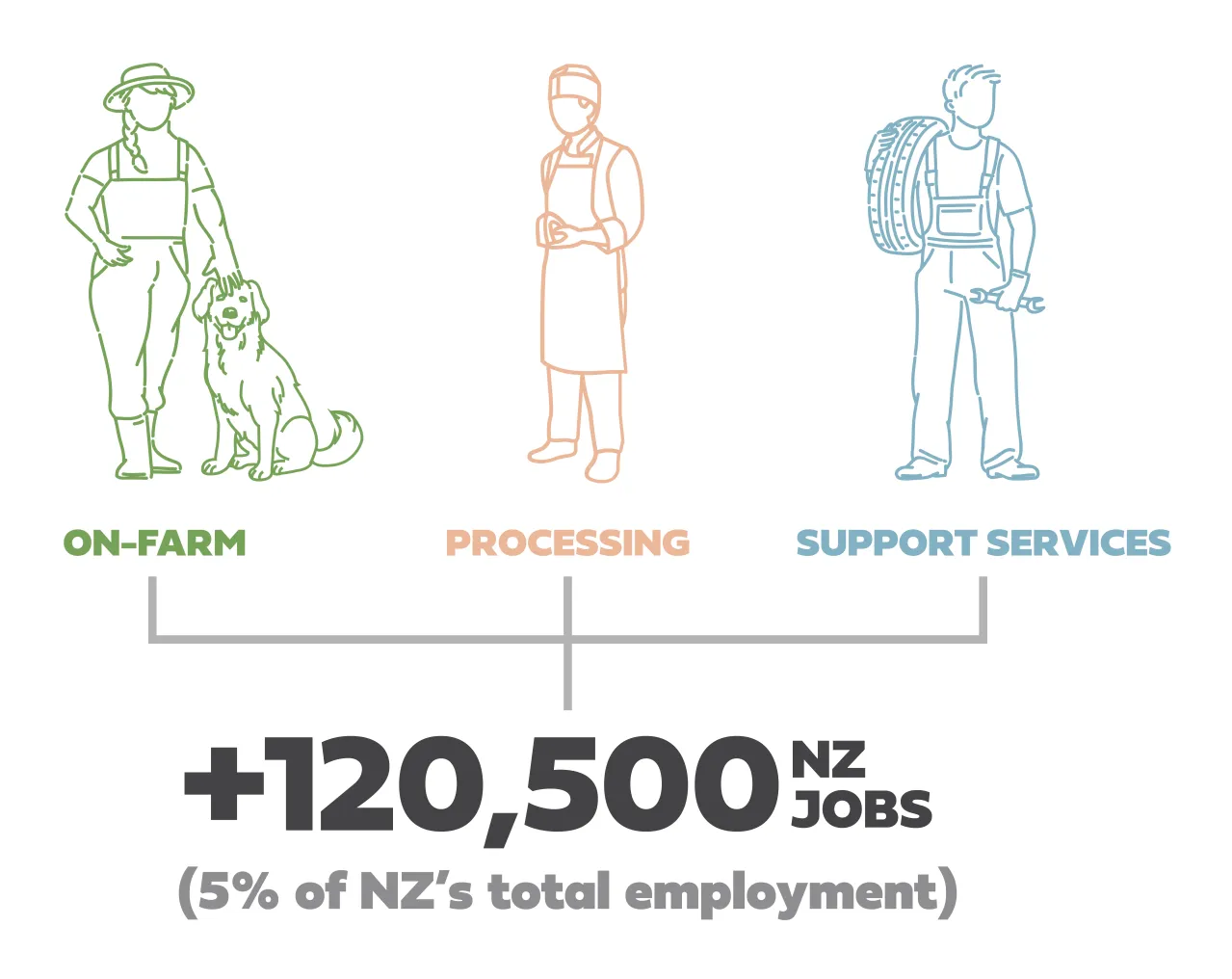
Our sector accounts for 5 percent of total employment in New Zealand – that’s over 120,500 people, on-farm and in processing and support services. 

(Source: BERL, 2026)  

a break down showing how the industry has contributed to employment =120,500 nz jobs

Māori and Pacific Peoples participation

icon of wallet

Our sector plays an important role in growing the Māori economy. Many farms are owned by Māori Trusts. Of the 42,000 individuals directly employed in New Zealand’s red meat sector, 25 percent (10,578) identify as Māori.  
Pacific Peoples also form an important part of the red meat sector’s workforce. 4,788 (11 percent) of the sector’s workforce identify as Pacific Peoples. 

Māori and Pacific Peoples employed directly in the red meat sector are proportionately much younger than the sector’s overall workforce, accounting for 56 percent of those working in the red meat sector aged 15-29 years. This makes them central to the sector’s future labour supply, especially in the meat processing industry. 

(Source: BERL 2026

Economic contribution

icon of hand over hand

The red meat sector generates $12.8 billion in income per year for New Zealand. It’s New Zealand’s second largest goods exporter and accounts for just over 12 percent of New Zealand’s total exports. 

(Source: BERL, 2026; The Treasury

The export value of New Zealand red meat has increased dramatically since 1990, with higher value ‘processed cuts’ rising from 53 percent to 98 percent of lamb exports. This has created greater economic and employment benefits through New Zealand’s rural communities. 

icon of family in house

On average, farmers and processors spend $64 million every day in communities and industries across New Zealand. When flow-on spending is included, this rises to $133 million a day being injected into New Zealand’s economy. 

(Source: BERL, 2026

icon of people/employees

The sheep and beef sector supports rural communities including schools, local businesses and community facilities, and creates a sense of identity in many regions of New Zealand.