
Our environment

image of rolling green pastures

All food production has environmental impacts. But the extent of these impacts varies, depending on how farming systems operate.  

In New Zealand, sheep and beef farming is primarily pasture-based, with animals grazing outdoors rather than being raised in confined systems. This difference influences how impacts such as greenhouse gas emissions, land use, water quality and biodiversity are measured and understood. 

While our farmers recognise there’s still more work to be done, there are some good environmental stories to tell about New Zealand’s red meat production, and how we’re making meat better. 

Environmental impacts

animated video icon

In this video, internationally recognised plant science and climate resilience researcher Prof Derrick Moot explains different food production systems and issues like soil carbon, water use, deforestation and more. 


image of particle representing carbon emissions

Greenhouse gas emissions from sheep and beef farming have decreased by 30 percent in absolute terms since 1990, while production levels have remained stable. 

(Source: Ministry for the Environment

We’re making great progress towards being climate neutral if you take into account the significant areas of carbon-sequestering woody vegetation on our sheep and beef farms, which is offsetting a substantial amount of our on-farm agricultural emissions.  

This woody vegetation (made up of indigenous forest, mānuka/kānuka, exotic forest, indigenous shrubland and exotic scrub) covers around 2 million hectares, or just under 20 percent of all sheep and beef farmland area, and around 77 percent of it is indigenous.  

icon of clipboard conveying NZ efficiency

Since 2003 the pastoral sector has invested around $80 million towards ways to reduce greenhouse gas emissions across the sector – including progress in selective breeding programmes in sheep which could reduce methane emissions by up to 1 percent per year. Other reductions have been made through improvements in factors such as feed and nutrition, and pasture management. 

Land use

icon showing sun above land

Sheep and beef farming in New Zealand takes place across a range of landscapes, including hill country and areas less suited to cropping. Land use patterns can influence both environmental pressures and opportunities, such as erosion risk, water quality and habitat for native species. 

icon showing two small trees growing in soil

There is concern globally about the amount of land used for livestock production, and deforestation as a result of increased livestock production (for example to grow crops for animal feed in feedlots). In New Zealand the trend has been in the opposite direction. The sheep and beef sector is using 4 million hectares less land than it was 30 years ago, with similar numbers of animals per hectare.  

icon of sun over mountains

At most times of the year, New Zealand beef and sheep farmers follow a form of rotational grazing, believed to be one of the most sustainable forms of livestock production. 

This process moves livestock around different sections of the pasture or between paddocks to prevent overgrazing and allow the land to renew, maintaining the health of the grass and soil while keeping carbon in the ground instead of being released into the air. 

Many cropping farmers in New Zealand are also sheep and beef farmers. The two work symbiotically together. These cropping systems leave the land fallow for a period of time and rotate the livestock into these paddocks to rebuild the soil naturally through manure – and the use of stock helps control weeds and pests. 

Biodiversity

image of icon representing a pine plantation

New Zealand’s indigenous biodiversity is unique and our farmers are kaitiaki (guardians) of the land. 24 percent of New Zealand’s total native vegetation (including woody native vegetation such as mānuka/kānuka and other native plants such as tussock) occurs on sheep and beef farmland. Land-use changes over the past 30 years have added 2 million hectares to the country’s conservation estate (the largest private sector contribution to biodiversity in New Zealand). 

(Source: Pannell, Buckley, Case, Norton, 2021

On average, approximately 25 percent of sheep and beef farms are covered by native vegetation. Much of this is regenerating and the sector is committed to continuing to build the biodiversity on our farms. 

Water use

image of irrigation icon

Thanks to the extensive native vegetation on New Zealand sheep and beef farms, along with predominantly pasture-fed, free-range livestock systems, farming relies far less on extracted water (such as irrigation) than many other farming approaches. For example, plant-based production often requires intensive irrigation. 

icon representing rainfall

Globally, there’s a lot of attention on water use. With plenty of natural rainfall in New Zealand, most water used in livestock production comes from the sky (‘green’ water, as opposed to being extracted from surface or ground water sources, known as ‘blue’ water). 

(Source: Zonderland-Thomassen et al

These are both a fraction of the water footprint of grain-fed meat production globally. 

animated video icon

In this video, Dr Stewart Ledgard, a world leader in Life Cycle Analysis, breaks down the science behind how much water is used to produce meat in New Zealand. Find out about comparing water footprint between food products and what conscious consumers should look for.

Water quality

icon show path running next to tree

All food production has the potential to impact on water quality due to a combination of factors, including local environmental conditions, farm management practices and stocking rates. Efforts to manage impacts include riparian planting, fencing waterways and changes to land use or farming practices. 

icon representing water testing

While there’s still work to do to improve freshwater health in some areas of New Zealand, including reducing nutrient losses to freshwater, New Zealand sheep and beef farms are doing their bit as they already have very low nitrogen leaching levels in comparison to other food producing systems. This is due to our generally low number of animals per hectare and low use of nitrogen fertiliser. 

Average nitrogen leaching rates of New Zealand red meat farms are 14-17 kg per hectare – not much more than forestry (avg 6-9 kg/ha). On other farming systems, the average nitrogen leaching is closer to 30-40 kg per hectare depending on the land use and soils, and can go higher than 100 kg per hectare for some horticultural crops. 

(Source: OverseerFM

 circular green‑and‑white icon featuring a heart‑shaped water droplet formed from two curved leaf‑like shapes, surrounded by a double‑lined border. The inner illustration shows stylised waves and organic shapes, suggesting care for water and nature.

The main impacts on water quality from sheep and beef production are sediment and E. coli. Measures of sediment and E. coli levels in waterways have been steadily improving over the last decade. 

Sediment, from land erosion, has been reduced by planting trees on slip-prone land, or retiring it (taking it out of production). E. coli has been reduced by keeping cattle out of waterways through fencing and other measures. Improving water quality continues to be an ongoing focus for farmers and the industry.

The farmer-led catchment communities movementis quickly spreading throughout New Zealand. There are hundreds of groups working together to make real differences to water quality, biodiversity and more in their areas. 

Eco-efficiency improvements

icon showing light bulb and arrow

Over the last 30 years, the sheep and beef sector has been producing more, with less. For example, New Zealand sheep numbers have reduced significantly (from 50 million to 27 million) on 4 million hectares less land, while sustaining similar levels of production, through innovation and improvements in farm practice. 

We are delivering greater value, with less overall impact.  
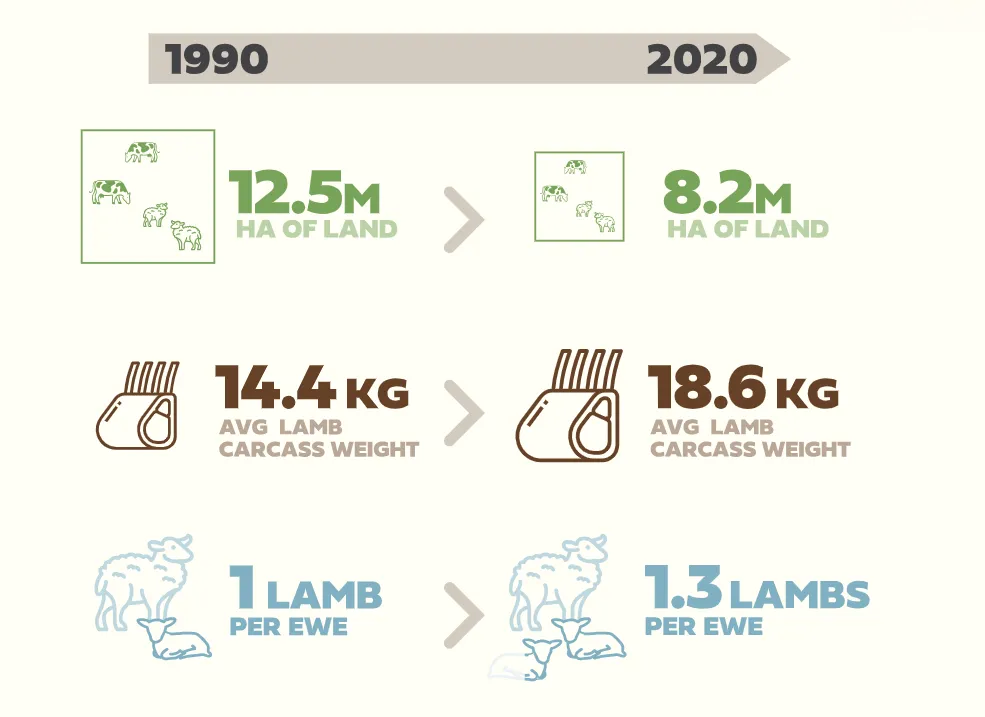
We are delivering greater value, with less overall impact. 

Infographic comparing sheep farming from 1990 to 2020. Land used decreases from 12.5 million hectares to 8.2 million hectares. Average lamb carcass weight increases from 14.4 kg to 18.6 kg. Lambs per ewe increase from 1 lamb to 1.3 lambs.